
Key features
Cost invoices:
- All accounting parameters in SAP - and any dependencies between these - are available at all times in Rydoo Accounts Payable, and can therefore be successfully used in data capture and AI learning.
Purchase orders:
- The integration enables 3-way matching of purchase orders, where goods receipt notes are synchronized between the systems, whether the invoice has arrived or not. Rydoo Accounts Payable performs automatic matching immediately whenever possible.
Accruals:
- Rydoo Accounts Payable captures period information from the invoices and suggests automatic periodization according to set limits. Ready accounted accrual lines are sent with the invoice to SAP, where it is automatically posted.
How it works
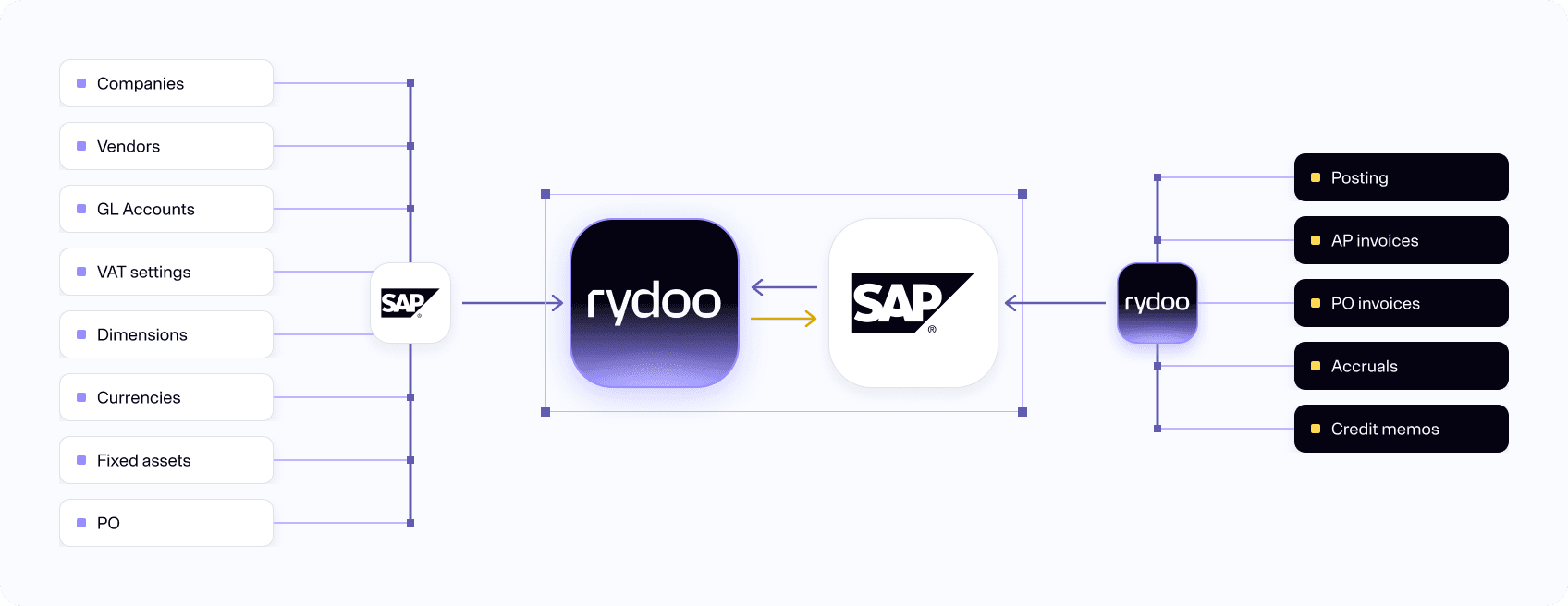
Rydoo Accounts Payable integrates with SAP ERP and SAP S/4HANA, bringing your financial data and invoice processing into one centralized platform. Data flows automatically between the two systems, cutting manual entry and reducing the risk of errors. With real-time visibility into your financial data, your team can make better-informed decisions.
Plug and play
Rydoo Accounts Payable is built with modern user interface principles in mind, using Rydoo Accounts Payable to automate the accounts payable process will give your users a modern and more effective tool than they are using today. By the use of machine learning and AI the error rate in the accounting process will drastically decrease.
The integration between Rydoo Accounts Payable and SAP ERP and SAP S4/HANA ensures that all relevant data is synchronized between the systems, so that you have full tracking of the vouchers, and that further processing of incoming invoices in ERP is not necessary.
FAQs
The integration between Rydoo Accounts Payable and SAP ERP/S4/HANA is achieved through the use of APIs (Application Programming Interfaces) which allow for the transfer of data between the two systems. This allows for seamless data transfer and real-time visibility into financial data, enabling users to make more informed decisions and improve overall financial management.
The integration allows for the transfer of financial data such as invoices, vendors, invoices, purchase orders, payment terms, accruals. This enables users through automation to drastically reduce the workload when it comes to accounting for the accounts payable process, by reducing the need for manual data entry and minimizing the risk of errors.
The cost for integration will depend on the specific implementation and the services required in addition to a maintenance fee.